
How to Choose the Right Materials for Your Remodel in South Bend and the Michiana Area
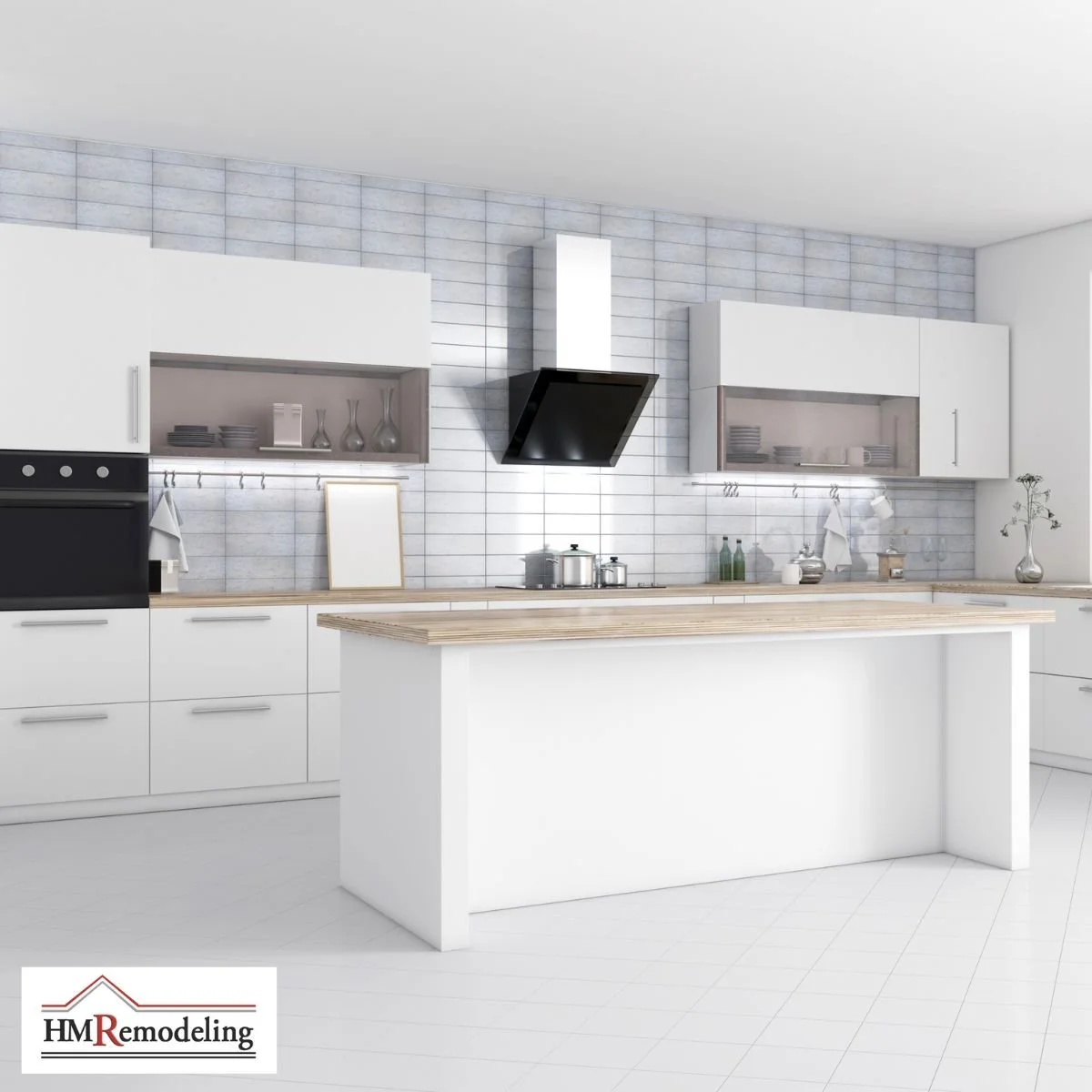
A clean, contemporary kitchen showcasing thoughtful material selection throughout, featuring handleless flat-front white cabinetry in both upper and lower configurations, a natural butcher block countertop on the center island, and matching butcher block perimeter surfaces. An angled black glass wall-mount range hood serves as a focal point above the cooktop wall, flanked by glass-front display cabinet sections with open shelving displaying dishware and glassware. A large-format light gray tile backsplash runs the full wall height, and a black built-in wall oven is integrated into the left cabinetry column. White tile flooring and recessed lighting maintain the bright, minimal palette throughout. This image illustrates the kind of material-forward kitchen remodel where cabinet construction quality, countertop selection, and surface durability are balanced with aesthetics, exactly the approach HM Remodeling applies for homeowners throughout South Bend and the Michiana region.
Why Material Selection Matters More Than Most Homeowners Realize
Every remodeling project eventually comes down to a series of material decisions. Flooring, cabinetry, countertops, siding, trim, tile, insulation, framing lumber, roofing, windows. Each one carries a price tag, a performance profile, and a set of trade-offs that are not always obvious at the point of selection. In showrooms and on design websites, materials are presented at their best, photographed under ideal lighting, and described in language that emphasizes appeal over accuracy. The homeowner's job, with the help of an experienced remodeler, is to look past the presentation and evaluate each material honestly against the specific demands of their home, their climate, and their long-term goals.
In South Bend and the Michiana area, that evaluation carries additional weight. The regional climate is genuinely demanding. Winters bring heavy snow, extended freezing temperatures, and repeated freeze-thaw cycles that stress building materials in ways that warmer climates simply do not produce. Summers bring heat and humidity that cause certain materials to expand, warp, or degrade if they were not selected with those conditions in mind. A material that performs beautifully in a mild climate may fail within a few seasons in a Michiana home. And a material that costs slightly more upfront but handles the regional climate with durability and stability will almost always prove to be the better investment over a ten or fifteen year horizon.
This is not a reason to approach material selection with anxiety. It is a reason to approach it with the right information and the right questions. Understanding what each material is actually made of, how it responds to moisture and temperature variation, what maintenance it requires to perform as advertised, and how it will look and function five or ten years from now is what separates a remodeling investment that holds its value from one that requires revisiting sooner than it should.
Material selection also intersects directly with budget management. One of the most common ways remodeling projects exceed their budgets is through material decisions that are made emotionally rather than strategically. A homeowner falls in love with a premium material in one category and then struggles to find room in the budget for other project components that matter just as much. A disciplined approach to material selection, one that allocates budget proportionally to visibility, durability, and functional impact, produces better overall results than chasing perfection in one area at the expense of the whole.
Starting With Performance, Not Aesthetics
The instinct in most remodeling decisions is to start with appearance. What does it look like? What color options are available? Does it match the design direction we are working toward? These are legitimate questions, but they are the second set of questions, not the first. The first set of questions should always be about performance.
For any material being considered in a Michiana remodel, the performance questions start with moisture. How does this material respond to moisture exposure, both direct and ambient? Does it absorb water, and if so, what happens when it does? Is it dimensionally stable in humid conditions, or does it expand and contract in ways that affect its integrity or appearance over time? For below grade applications, outdoor applications, or any space in an older South Bend home where moisture management is an active concern, these questions are not optional. They are the foundation of a sound material decision.
The next performance question is thermal behavior. In a climate with South Bend's temperature range, materials that are installed at exterior walls, in below grade spaces, or in spaces with significant solar exposure need to handle thermal movement without failing at joints, seams, or fastener points. Caulk joints fail. Fasteners back out. Grout cracks. These are often not installation failures. They are material selection failures, cases where a material was chosen without adequate consideration of how it would behave across the full range of temperatures it would experience in this specific climate.
Durability under daily use is the third performance dimension. A countertop that looks stunning in a showroom but scratches, stains, or chips under normal cooking activity is a poor choice regardless of its aesthetic appeal. A floor material that photographs beautifully but shows wear patterns within two years of installation in a household with children or pets is a poor choice regardless of its price point. Asking specifically how a material performs under the actual conditions it will experience, and seeking out reviews and feedback from homeowners in comparable climates and household situations, produces far better outcomes than relying on manufacturer descriptions alone.
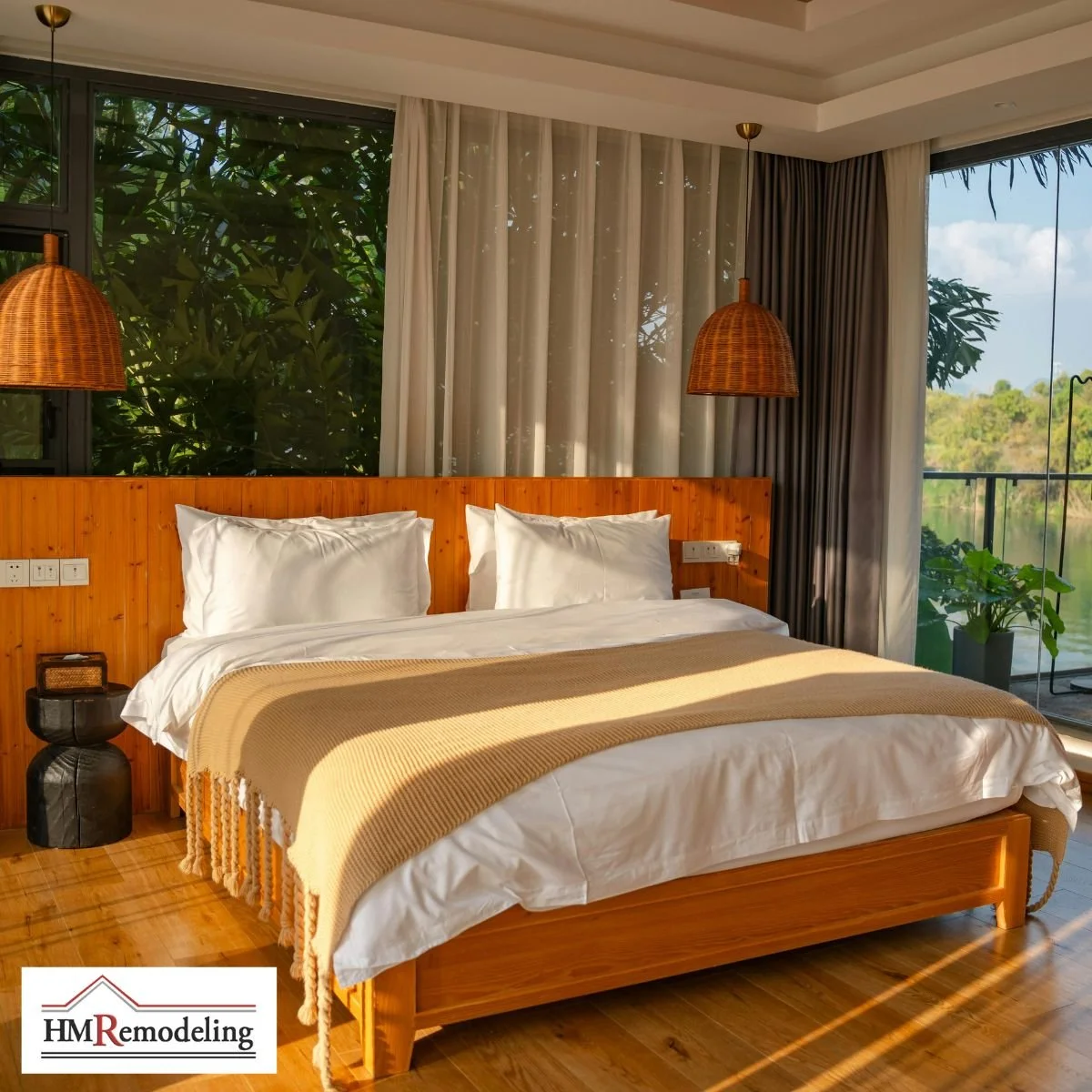
A warmly appointed bedroom remodel showcasing material selections centered on natural wood tones and abundant natural light. Wide-plank engineered hardwood flooring in a warm honey finish runs throughout the room, complemented by a full-width natural wood plank wall panel that serves as the headboard backdrop. A wood platform bed frame with crisp white bedding and a tan knit throw runner is positioned at the center. Two wicker dome pendant lights in warm rattan tones hang on either side of the bed from brass ceiling mounts. Black-framed floor-to-ceiling windows and a sliding glass door open to a lush garden and water view, with sheer linen curtains and dark drapes framing both openings. A low dark wood stool and potted tropical plant add natural texture. This image illustrates how material choices for flooring, wall treatments, and windows work together to define the warmth and livability of a finished bedroom, the type of thoughtful selection guidance HM Remodeling provides to homeowners throughout South Bend and the Michiana region.
Exterior Materials Built for Michiana Winters
Exterior material selection in South Bend is an area where regional knowledge pays significant dividends. The difference between a siding product that holds up through fifteen Michiana winters and one that begins showing visible degradation within five years is often a question of material composition, installation method, and whether the product was genuinely engineered for cold climates or simply marketed broadly.
Fiber cement siding has become one of the most consistently recommended exterior cladding options for older Michiana homes, and the performance record in this region supports that recommendation. It does not absorb moisture, it does not warp or cup through freeze-thaw cycling, it holds paint well, and it resists the impact damage from hail and wind-driven debris that South Bend storms occasionally produce. Properly installed fiber cement with a quality paint system and correctly caulked joints at all penetrations and trim interfaces will perform for decades with minimal maintenance beyond periodic repainting.
Vinyl siding remains a common choice in this market because of its upfront cost advantage, and modern vinyl products are significantly better than the products installed on Michiana homes in the 1980s and 1990s. Thicker gauge vinyl with insulated backing performs acceptably in this climate. Thin gauge vinyl without backing, however, becomes brittle in extreme cold and is prone to cracking from impact during winter months. If vinyl is the direction, product quality within that category matters considerably.
For trim, windows, and door surrounds, cellular PVC trim board has largely replaced wood in exterior applications for good reason. It does not rot, it does not absorb moisture, it holds paint well, and it maintains its dimensional stability through the kind of temperature swings that cause wood trim to crack, peel, and separate over time in a climate like South Bend's. The investment over wood trim pays for itself quickly when the ongoing maintenance costs of painted wood exterior trim in this climate are factored in honestly.
Interior Material Decisions That Affect Long Term Value
Interior material selection in a Michiana remodel involves a different set of performance considerations, but the discipline of starting with function rather than aesthetics applies equally. For flooring, the question of moisture vapor transmission from concrete slabs in below grade and on-grade applications eliminates certain materials from consideration entirely and narrows the field for others. Solid hardwood flooring, as noted in previous discussions of basement applications, is not appropriate for any below grade installation in this climate. Even in on-grade applications over concrete, solid hardwood requires careful moisture testing and vapor mitigation before installation to perform reliably through Michiana's seasonal humidity swings.
Engineered hardwood extends the application range of wood flooring in Michiana homes because its layered construction resists the dimensional movement that solid wood experiences in response to humidity changes. It can be installed in spaces where solid hardwood would be problematic, and it delivers a genuine wood surface appearance and feel that resonates with buyers in the local market. Its limitations are in refinishing longevity, specifically the wear layer thickness determines how many times the floor can be sanded and refinished over its lifespan, which is a meaningful consideration for homeowners planning a long-term ownership horizon.
For kitchens and bathrooms, tile remains one of the most reliable material choices in Michiana homes because of its dimensional stability, moisture resistance, and longevity. The performance of a tile installation, however, is heavily dependent on substrate preparation and installation quality. Tile installed over a substrate that flexes, moves, or is not properly waterproofed in wet areas will crack at grout joints and potentially at the tile face regardless of the tile quality itself. Material selection and installation quality are inseparable in tile applications, which is why choosing an experienced installer matters as much as choosing a quality product.
Cabinet and Countertop Selection in a Michiana Home
Cabinetry is one of the largest single line items in most kitchen and bathroom remodels, and it is an area where the gap between product quality levels is significant and not always visible at first glance. Two cabinet lines can look nearly identical in a showroom photograph while differing enormously in how they perform over ten years of daily use in a Michiana home.
The most important structural distinction in cabinet construction is box material. Plywood box construction outperforms particleboard and medium density fiberboard in residential applications for a straightforward reason. Plywood holds fasteners more reliably, resists moisture-related swelling and degradation more effectively, and maintains its structural integrity through the humidity variation that older South Bend homes experience more acutely than newer, better-sealed construction. In a kitchen or bathroom where steam, splashing, and seasonal humidity are ongoing realities, the box material is not a cosmetic decision. It is a durability decision that affects how the cabinets perform and look a decade from installation.
Door and drawer front construction, hinge quality, and drawer slide hardware are the other dimensions of cabinet quality that separate products that hold up from those that begin showing wear relatively quickly. Soft-close hinges and undermount drawer slides are now standard in mid-range and above cabinet lines, and they should be considered a baseline expectation rather than an upgrade in any remodel intended to hold its value. These components are the most mechanically stressed parts of a cabinet installation, opening and closing hundreds of times per year, and their quality determines how the cabinets feel and function long after the finish work is complete.
Countertop selection in Michiana remodels has shifted strongly toward quartz over the past decade, and the reasons are well grounded in performance. Quartz countertops are engineered stone, combining natural quartz content with resin binders that produce a non-porous, highly consistent surface. They do not require sealing, they resist staining from the acids and pigments common in food preparation, and they handle the thermal and humidity variation of a Midwest kitchen without the cracking and joint separation that some natural stone products experience over time. For homeowners who want the appearance of natural stone with significantly less maintenance demand, quartz is a strong fit for this market.
Natural stone countertops, particularly granite and marble, remain popular choices in higher-end Michiana remodels, and they are legitimate options when their maintenance requirements are understood and accepted from the outset. Granite is durable and heat resistant but requires periodic sealing to maintain its stain resistance. Marble is beautiful but significantly softer and more porous than granite, making it a poor choice for high-use kitchen surfaces in households that cook regularly. In bathroom vanity applications where use intensity is lower, marble performs more reliably and its aesthetic qualities are a genuine differentiator.
Windows and Doors in an Older South Bend Home
Window and door replacement in older Michiana homes is one of the highest-impact material decisions available to a homeowner, both for energy performance and for the overall quality impression of the finished remodel. Homes built before the 1980s in South Bend frequently have single-pane or early double-pane windows that leak significant amounts of conditioned air and contribute meaningfully to heating and cooling costs in a climate where both are substantial.
Modern window products for the Michiana market should be evaluated on several performance dimensions. The U-factor measures the rate of heat transfer through the window assembly. The lower the U-factor, the better the window insulates. In South Bend's heating-dominated climate, a low U-factor is the primary performance target. Solar heat gain coefficient, which measures how much solar energy passes through the glass, is a secondary consideration that matters more for south and west facing windows where summer sun exposure is significant.
Frame material selection in windows and exterior doors matters considerably in this climate. Fiberglass frames offer the best dimensional stability across temperature extremes and do not conduct cold the way aluminum frames do. Vinyl frames perform well in this climate at a lower price point than fiberglass and represent the dominant choice in the Michiana replacement window market. Wood frames require maintenance discipline that many homeowners underestimate, and in a climate with South Bend's moisture and temperature variation, wood frame windows that are not properly maintained deteriorate relatively quickly at the exterior face.
Exterior door systems deserve the same level of scrutiny. A fiberglass or steel door with a properly insulated core and a quality frame system with thermal break construction delivers dramatically better energy performance than the original wood doors found in most of South Bend's older housing stock. The weatherstripping system and threshold seal are as important as the door itself, since a high-quality door installed in a poorly air-sealed frame will still allow significant air infiltration at the perimeter.
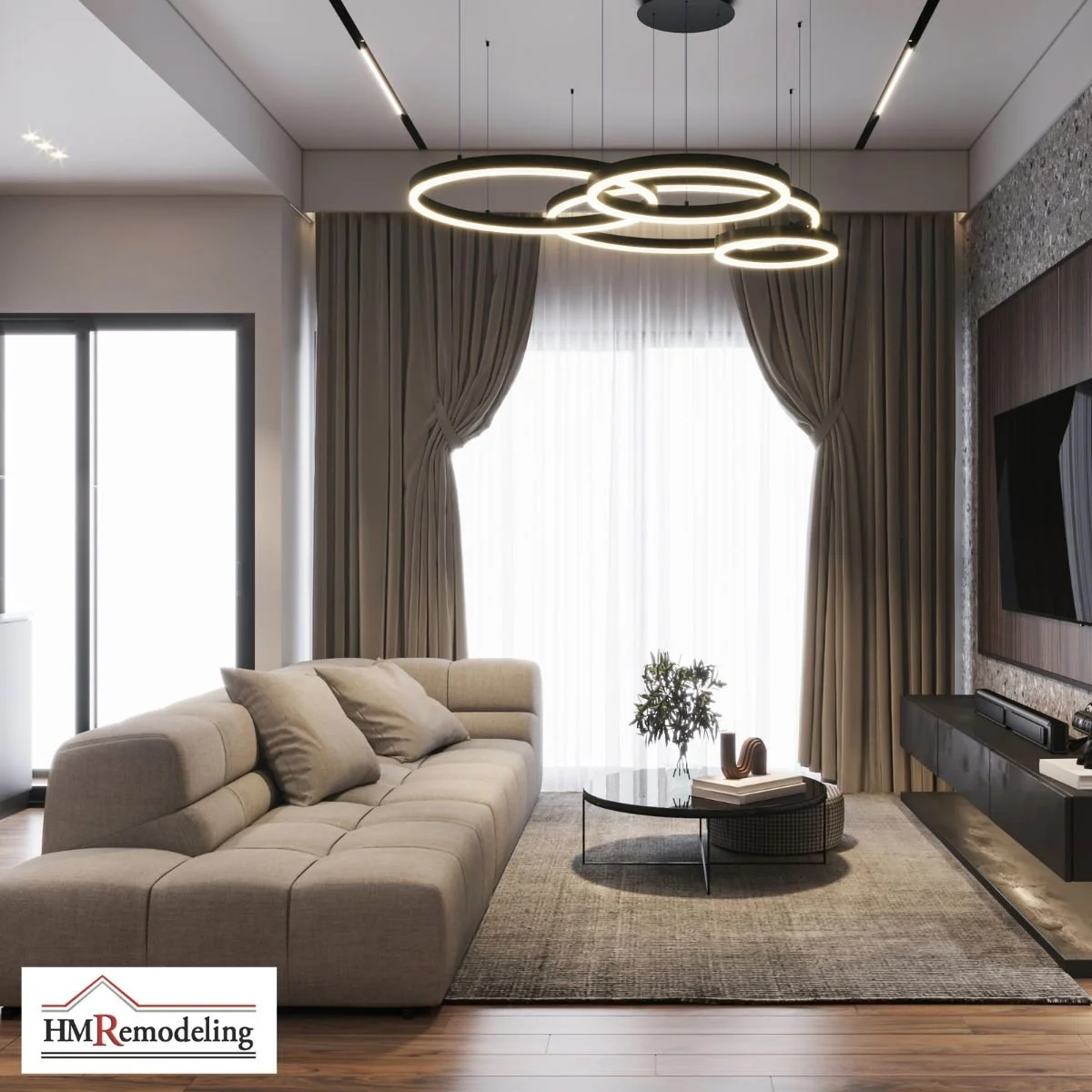
A sophisticated modern living room remodel featuring rich dark-toned hardwood flooring throughout, a dramatic multi-ring LED chandelier with overlapping black metal circular frames serving as the room's central focal point, and a full-height textured stone accent wall housing a wall-mounted flat screen television and a low-profile dark wood media console with a soundbar. A wide beige tufted modular sofa sits centered on a large gray textured area rug, with a round black metal and glass coffee table holding a vase of greenery and decorative objects. Floor-to-ceiling taupe velvet drapes frame a large window with sheer underlayer, and a black-framed sliding glass patio door is visible on the left. Linear track lighting on the ceiling perimeter provides additional ambient illumination. This image reflects how flooring material quality, accent wall treatment, window and door selection, and lighting design work together to produce a cohesive, high-performing living room remodel, exactly the material selection approach HM Remodeling applies for homeowners throughout South Bend and the Michiana region.
Working With a Remodeler Who Knows the Materials
Material selection knowledge is one of the clearest differentiators between remodeling contractors in any market. An experienced remodeler who has worked extensively in South Bend's older housing stock has seen firsthand how different materials perform through Michiana winters, how products that are marketed broadly actually hold up in this specific climate, and where the value gaps between product tiers are genuine versus where they are primarily cosmetic.
This knowledge translates directly into better outcomes for homeowners. It prevents the selection of materials that look appropriate but fail prematurely in this climate. It identifies where spending more produces meaningful long-term value and where mid-range products perform just as well as premium ones. And it helps homeowners allocate their remodeling budget in proportion to where the investment will actually be visible, functional, and lasting.
For Michiana homeowners navigating material decisions for any remodeling project, having a knowledgeable local partner in that process is not a luxury. It is the most reliable way to ensure that the choices made today produce a home that performs, looks great, and holds its value for years to come.
Frequently Asked Questions
How do I compare material quality when everything looks similar in a showroom? Ask specifically about material composition, not just finish appearance. For cabinets, ask whether the box is plywood or particleboard. For flooring, ask about the wear layer thickness and the core material. For siding, ask about the gauge and whether the product is rated for freeze-thaw conditions. These questions reveal quality differences that photographs and surface appearances do not.
Is it worth spending more on materials for a home I plan to sell in a few years? In most cases, yes, but with calibration. The goal is to select materials that present well, perform reliably, and do not require replacement or repair before or shortly after the sale. Overspending on premium materials beyond what the neighborhood market supports is not necessary. Underspending on materials that fail visibly or functionally before the sale is a false economy.
How do I know which materials are appropriate for South Bend's climate specifically? Work with a remodeler who has a substantial track record in the Michiana market. Regional experience with specific products and how they perform through local winters and summers is knowledge that no product specification sheet can replace. Ask your remodeler directly how a material they are recommending has performed on past projects in this climate.
What materials should I prioritize if my budget requires trade-offs? Prioritize materials at the intersection of high visibility and high use. Kitchen countertops, flooring in primary living areas, exterior cladding, and windows are the areas where material quality most directly affects daily experience, long-term performance, and resale value. These are the categories where investing in quality produces the most durable return.
Make Confident Material Decisions With HM Remodeling by Your Side
The right materials make a remodel last. The wrong ones create maintenance headaches, premature failures, and regret. HM Remodeling of South Bend brings the regional knowledge and hands-on experience to help Michiana homeowners make material decisions that are grounded in performance, calibrated to budget, and built to hold up through everything this climate delivers.
Reach out today to schedule a consultation and start your remodel with confidence.
HM Remodeling of South Bend
(574) 217-4384
hmremodelingsb.com
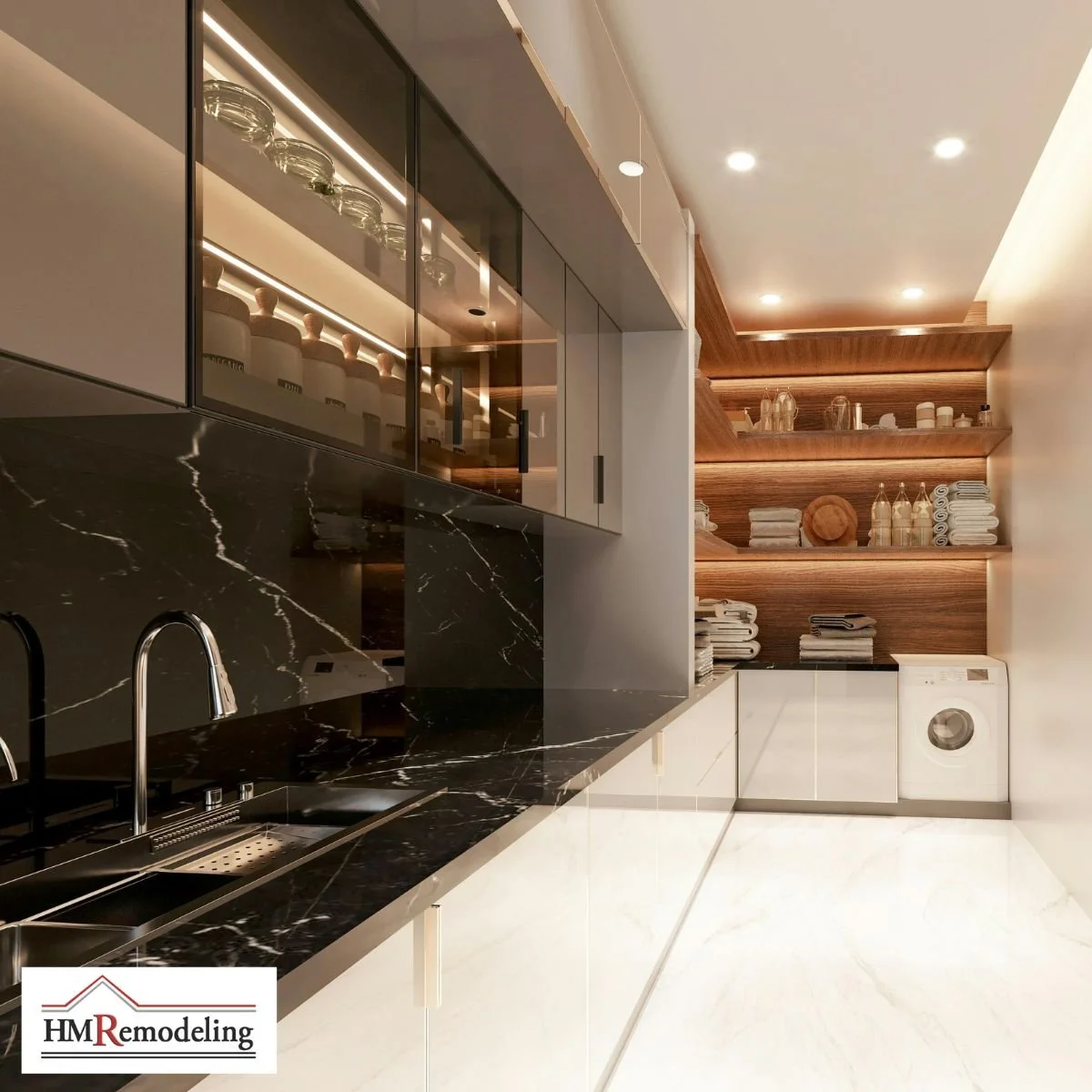
A premium kitchen remodel featuring a dramatic black marble slab countertop and full-height matching backsplash with bold white veining, paired with smoked glass-front upper cabinet doors with warm LED interior shelf lighting displaying glassware, ceramic canisters, and storage vessels. A chrome pull-down gooseneck faucet is mounted into the black marble surface above an undermount workstation sink with a stainless drain rack. Large-format white marble tile flooring runs throughout the space. The adjacent laundry alcove visible in the background features warm walnut open shelving with LED accent lighting, neatly organized with rolled towels, bottles, and dishware, alongside a front-load washing machine below. Recessed ceiling lighting and a pendant light fixture provide layered illumination. This image demonstrates how premium material selection in countertops, cabinetry, flooring, and shelving systems work together to create a cohesive, high-performing remodel, the level of craftsmanship HM Remodeling delivers to homeowners throughout South Bend and the Michiana region.
