
Small Basement Improvements That Add Extra Living Space in South Bend and the Michiana Area
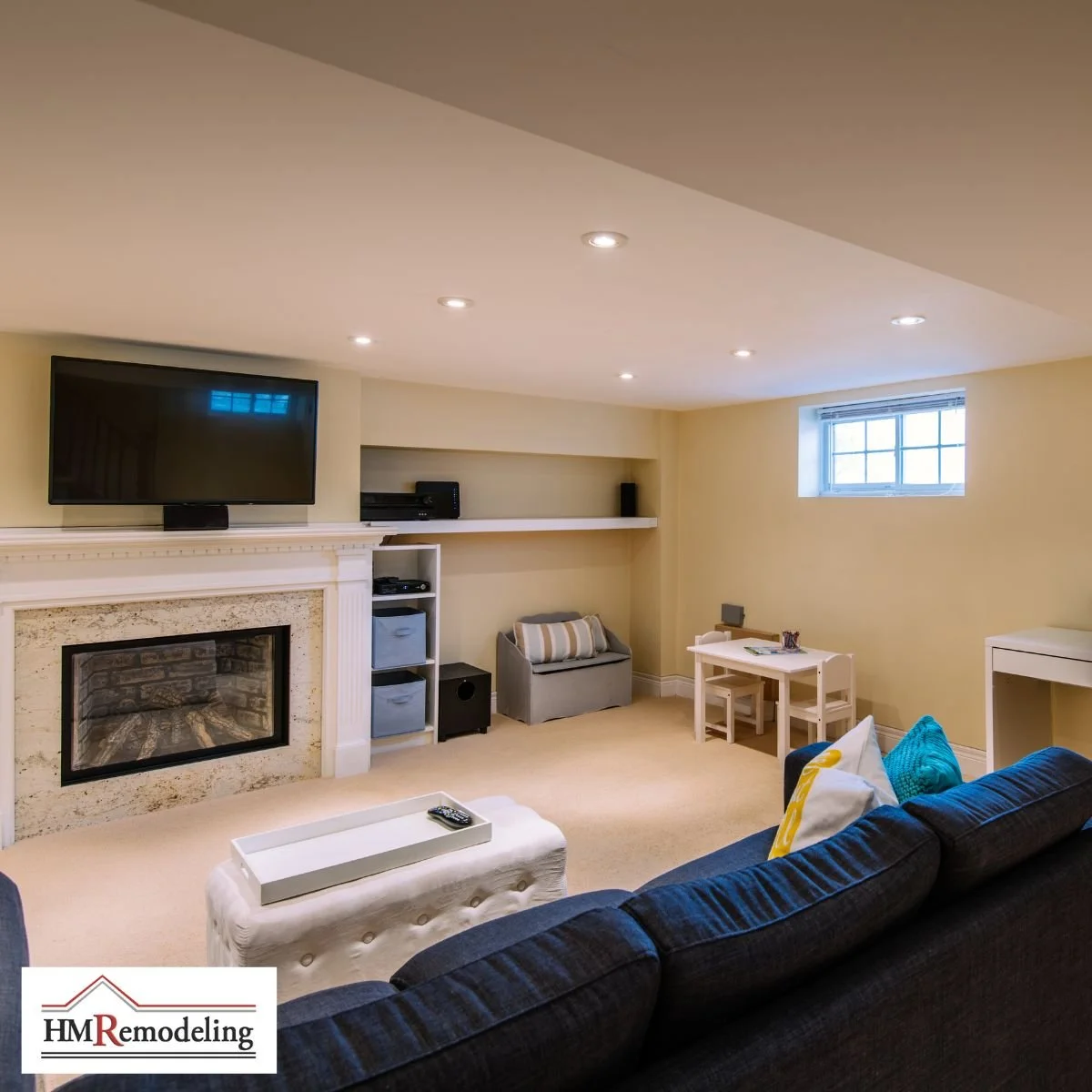
A fully finished basement family room featuring a linear gas fireplace with a natural stone tile surround and white painted wood mantel, flanked by a built-in media niche with open shelving housing a soundbar, receiver, and storage bins. A large wall-mounted flat screen television sits above the mantel. A navy blue sectional sofa faces the fireplace across a white tufted storage ottoman coffee table. Recessed ceiling lights provide even ambient illumination throughout the warm cream-painted space, and a small egress window on the right wall admits natural light. A children's activity table and chairs are visible in the background alongside a small white desk unit. Neutral carpet flooring adds comfort and warmth underfoot. This image represents the kind of complete, livable basement family room HM Remodeling creates for homeowners throughout South Bend and the Michiana region, turning unused below-grade square footage into valuable daily living space.
Why Michiana Basements Are an Untapped Opportunity
Ask most South Bend homeowners what is in their basement and the answer is usually some variation of the same list. A water heater. A furnace. Some boxes that have not been opened since the last move. Maybe a workbench along one wall and a utility sink that gets used twice a year. The basement exists, it functions in a mechanical sense, and it is otherwise ignored.
This is one of the most common missed opportunities in Michiana residential real estate. South Bend and the surrounding area have a housing stock built heavily in the mid-twentieth century, and a significant portion of those homes sit on full basements with eight-foot or higher ceilings, solid concrete block or poured foundation walls, and square footage that rivals the main floor. That space is already there. It is already heated and cooled to some degree as part of the home's mechanical system. And in a market where finished square footage directly affects both appraised value and daily quality of life, leaving it unfinished is a choice that costs homeowners more than they realize.
The good news is that transforming a basement into usable living space does not require a massive renovation budget or months of construction. Targeted, well-planned improvements can convert even a modest basement into a room that serves a real daily purpose, whether that is a family room, a home office, a guest suite, a workout space, or a combination of uses that adapts as the household's needs change over time.
But before any of that can happen, the basement has to be understood honestly. In older Michiana homes, basements come with a specific set of challenges that need to be addressed in the right sequence. Skipping steps or working around problems rather than solving them is how basement finishing projects end up with moisture issues, comfort problems, and finishes that deteriorate faster than they should.
Addressing Moisture Before Anything Else
Moisture is the defining issue in Michiana basements, and it needs to be the first conversation in any basement improvement project. South Bend's climate produces significant precipitation year round, and the region's soil composition means that groundwater moves toward foundation walls with meaningful pressure during wet seasons. Spring snowmelt and heavy summer rain events are the moments when basement moisture problems announce themselves most clearly, but the conditions that allow water in are present all year.
In older South Bend homes, foundation walls were built without the waterproofing membranes and drainage systems that modern construction includes as standard practice. Over decades, mortar joints in block foundations develop hairline cracks. Poured concrete walls develop shrinkage cracks. Floor-to-wall joints, which are a common entry point for water, may have never been properly sealed. Window wells that were adequate when the home was built may now be below grade due to soil settlement or landscaping changes.
None of this means the basement cannot be finished. It means the moisture situation needs to be evaluated honestly and addressed appropriately before framing, insulation, or drywall goes in. Finishing over an active moisture problem does not solve the moisture problem. It hides it temporarily and creates conditions for mold growth, wood rot, and material failure that will be far more expensive to correct once the finished surfaces have to be torn out.
A proper moisture assessment looks at the foundation walls for efflorescence, which is the white mineral deposit left behind when water moves through masonry. It looks at the floor for staining patterns that reveal where water pools or migrates. It evaluates the grading around the exterior of the home and the condition of gutters and downspouts, because a significant percentage of basement moisture problems in older Michiana homes are caused by surface water that is not being directed away from the foundation effectively.
Solving moisture issues may be as simple as improving exterior drainage and sealing minor cracks with hydraulic cement and waterproofing membrane. Or it may involve installing an interior drainage system and sump pump. The right solution depends on the specific conditions, and getting that assessment right is what determines whether the finished basement performs well for decades or develops problems within a few years.
Insulation and Comfort in a Midwest Basement
Once moisture is confirmed to be under control, the next foundational improvement is insulation. An uninsulated basement in South Bend is genuinely uncomfortable for much of the year. Foundation walls conduct cold directly from the soil, which in Michiana stays cold well into spring and returns to cold early in fall. A basement room with uninsulated concrete walls will feel cold and damp regardless of how attractive the finishes are, and it will drive up heating costs as the home's mechanical system works to compensate.
The most effective approach for Michiana basements is rigid foam insulation applied directly to the foundation walls before framing. This creates a thermal break between the cold concrete and the interior framing, eliminates the cold wall effect, and does not create a cavity where moisture can accumulate and support mold growth the way that batt insulation in a framed wall cavity can. Rigid foam is also dimensionally stable, meaning it holds its position and performance over time without settling or compressing.
For basement floors, sleepers with rigid foam underneath a subfloor panel system create a warmer, more comfortable surface than concrete alone and allow for virtually any finish flooring to be installed above. Engineered hardwood, luxury vinyl plank, and tile all perform well over a properly prepared basement floor system in this region. Solid hardwood is not recommended in below-grade applications in Michiana's climate due to the humidity variation the material will experience over the course of a year.
Ceiling insulation between the basement and the first floor also matters for sound control, which becomes significant when the basement transitions from storage to living space. A basement family room or bedroom directly below the main living area benefits substantially from acoustic insulation in the ceiling cavity, both for the occupants below and for those above.
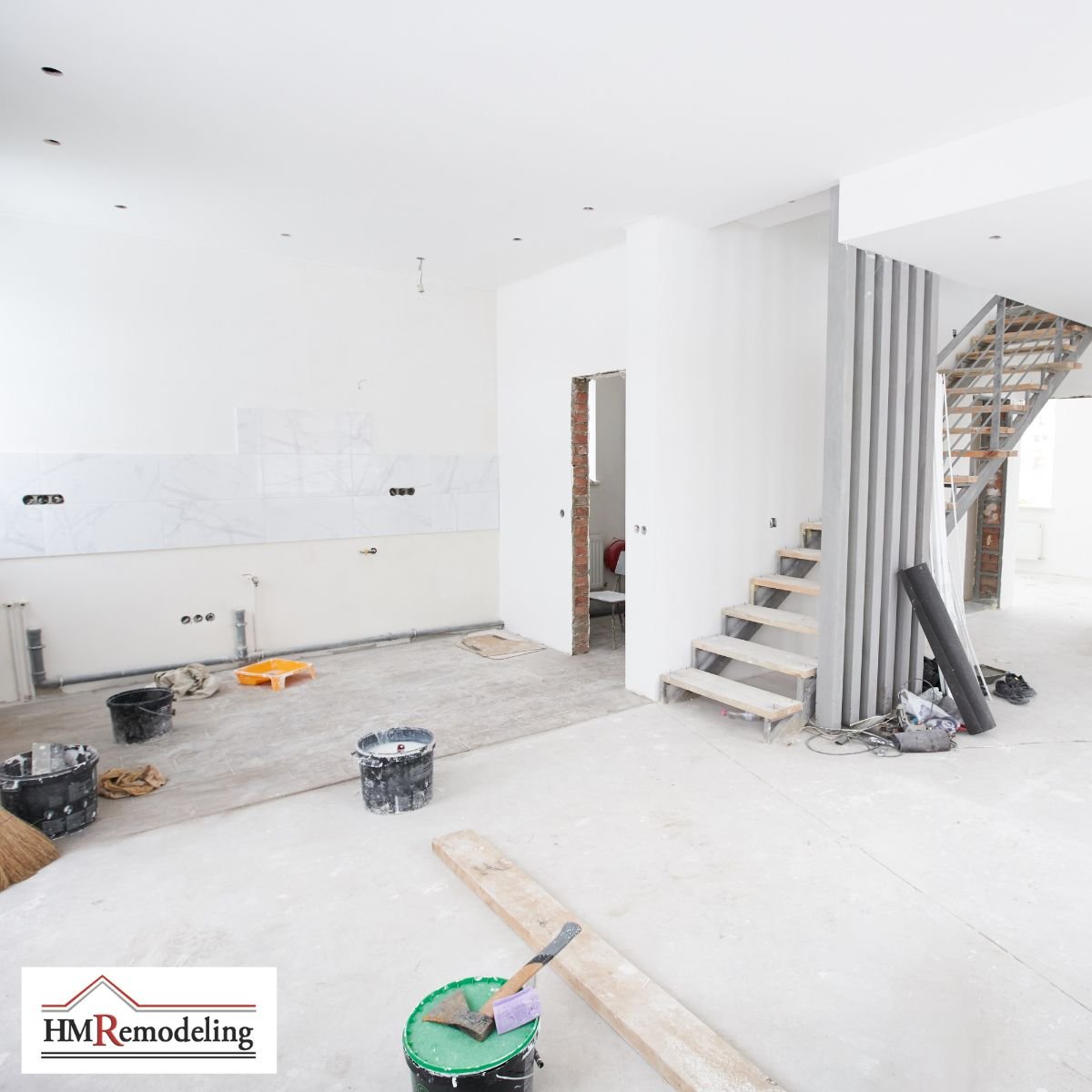
An active basement finishing project mid-construction, showing a large open below-grade living area with freshly installed and partially finished white drywall, recessed lighting cans roughed into the ceiling, and plumbing supply and drain lines protruding from the concrete floor awaiting future fixture installation. A partially framed staircase with open metal stringers and rough wood treads leads to the upper level on the right side of the frame. A doorway opening with exposed brick reveals an adjacent room in progress. Construction tools, paint buckets, mortar mixing containers, and drop cloths are spread across the concrete subfloor. This image captures the behind-the-scenes process of a professional basement transformation, illustrating the sequenced, code-compliant approach HM Remodeling takes when converting unfinished Michiana basements into functional living space for homeowners throughout South Bend and the surrounding region.
Framing and Layout Planning for Real Usability
The framing plan for a basement living space is where functional decisions get locked in, and it deserves more thought than it typically receives. Homeowners often approach basement framing as a straightforward perimeter exercise, running walls along the foundation and leaving a large open space in the middle. This works for some uses but produces awkward, undefined spaces that do not function as well as a more intentional layout would.
Start with the mechanical equipment. The water heater, furnace, electrical panel, and any other mechanical systems need to remain accessible for service and code compliance. Framing a mechanical room that contains these systems cleanly, with a proper door and adequate clearance, frees the rest of the basement to be finished without compromise. A mechanical room that is thoughtfully designed also makes the finished space look more intentional and complete rather than looking like a finished basement with equipment sitting awkwardly in a corner.
From there, the layout should follow the intended use. A basement designed for family use with a dedicated play area benefits from an open central space with defined zones rather than a single undifferentiated room. A basement that will include a guest bedroom requires a properly framed and permitted egress window opening, which is a code requirement in South Bend and throughout Indiana for any sleeping room below grade. Planning for this from the start of the framing process is far less disruptive and less expensive than adding it later.
Soffits for ductwork and plumbing runs that cross the ceiling are another framing consideration that shapes how the finished space looks and feels. Thoughtful soffit design that follows the geometry of the room and aligns with the overall layout produces a finished basement that feels intentional. Soffits that run arbitrarily across the center of the room or drop ceiling height in the most visible areas create a cramped feeling that no amount of good lighting fully overcomes.
Lighting That Transforms a Below Grade Space
Lighting is one of the most impactful and most underestimated elements of a basement improvement project. Below grade spaces have no natural light from exterior walls and limited or no window light depending on the configuration of the home. A basement that is poorly lit will feel like a basement regardless of how well it is finished. One that is thoughtfully lit can feel as comfortable and inviting as any room in the house.
Recessed lighting is the standard approach for basement ceilings and for good reason. It does not reduce ceiling height, it distributes light evenly, and it works with virtually any aesthetic direction. The key is density and placement. A single row of recessed cans down the center of a room leaves the perimeter in shadow. A properly spaced grid that accounts for the room's dimensions and the furniture layout produces even, comfortable illumination throughout the space.
Layering light sources adds depth and livability. Recessed cans handle ambient light. Sconces, floor lamps, and under-cabinet or shelf lighting handle accent and task lighting. In a basement family room or home office, having multiple circuits on dimmer switches gives occupants control over the atmosphere of the space, which matters more in a below grade room than almost anywhere else in the home.
For basements being converted to home offices, which has become an increasingly common use in South Bend households following the shift toward remote and hybrid work, lighting that supports video calls and focused work is a specific requirement. Warm overhead light combined with a dedicated task light at the desk position, and ideally some diffuse light behind the monitor to reduce eye strain, produces a workspace that is genuinely comfortable for extended daily use.
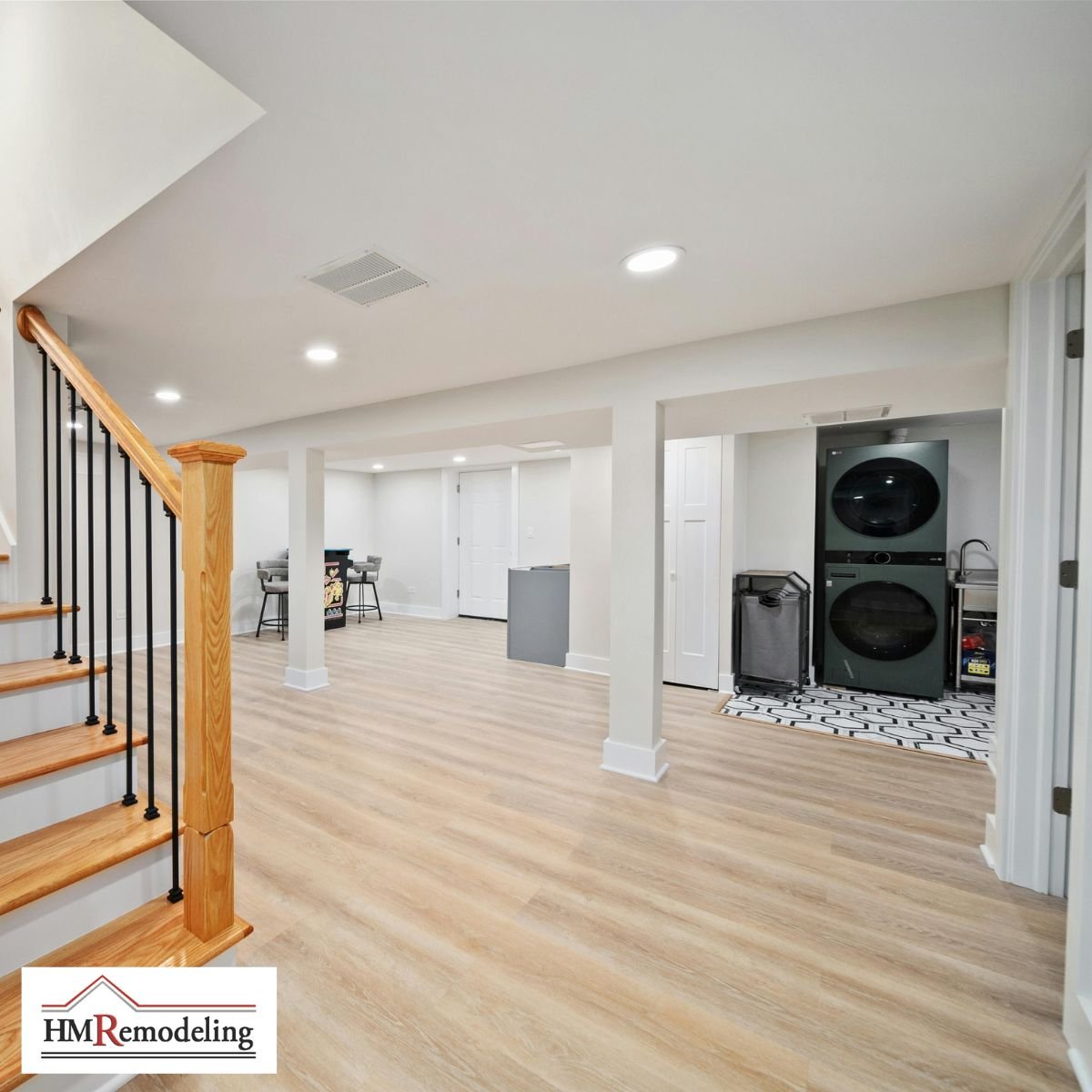
A clean, open finished basement featuring light gray luxury vinyl plank flooring throughout a wide open living area with white painted drywall walls, white painted support columns with square bases, and evenly spaced recessed ceiling lighting. A wood staircase with natural oak treads and black iron baluster railing descends from the main floor on the left side of the frame. An open laundry alcove on the right houses a stacked dark green LG washer and dryer unit with laundry hampers and a black and white geometric tile floor. Additional doorways lead to separate finished rooms beyond, and an HVAC supply vent is visible in the ceiling. This image illustrates the thoughtful, functional layout planning HM Remodeling applies when finishing Michiana basements, creating organized multi-use spaces that add real square footage and daily value to homes throughout South Bend and the surrounding area.
Flooring, Finishing, and the Details That Make It Feel Complete
Once framing, insulation, mechanical rough-in, and lighting are addressed, the finishing selections are what give a basement its personality and livability. In Michiana homes, flooring choice is one of the most consequential finish decisions because the below grade environment requires materials that handle moisture vapor transmission from the concrete slab without degrading.
Luxury vinyl plank has become the dominant basement flooring choice in this market and with good reason. It is dimensionally stable, fully waterproof, comfortable underfoot, and available in finishes that convincingly replicate hardwood and stone. It installs quickly and handles the humidity variation of a South Bend basement without gapping, cupping, or swelling. For homeowners who want the warmth of a softer surface in a portion of the space, area rugs over luxury vinyl plank perform well and can be removed and replaced easily if moisture events occur.
Drywall finishing, trim work, and paint are where the basement transitions from a construction project to a room. These details matter more than homeowners often expect. Clean corner bead, properly finished drywall joints, and thoughtfully selected trim profiles are what separate a basement that looks finished from one that looks like a finished basement. The distinction is real and buyers notice it.
Frequently Asked Questions
Do I need a permit to finish my basement in South Bend? In most cases, yes. Any work that involves framing new walls, adding electrical circuits, or creating a sleeping room requires permits and inspections through the City of South Bend's building department. Working with a licensed remodeler ensures the project is permitted properly and passes inspection, which matters both for safety and for resale.
How do I know if my basement is a good candidate for finishing? The most important factors are ceiling height, moisture history, and the condition of the mechanical systems. Basements with at least seven feet of clearance, no active moisture issues, and mechanical systems in reasonable condition are strong candidates. A walkthrough with an experienced remodeler will identify any conditions that need to be addressed before finishing work begins.
How long does a basement finishing project typically take in a Michiana home? A straightforward basement finish in a mid-sized South Bend home typically runs six to ten weeks from framing through final trim and paint, depending on the scope and whether any moisture remediation or mechanical updates are required. Projects with more complex layouts or older homes that reveal additional work during framing may run longer.
What is the return on investment for finishing a basement in South Bend? Finished basement square footage adds meaningful appraised value in the Michiana market and consistently increases buyer interest. The return depends on the quality of the finish and the overall condition of the home, but a well-executed basement improvement is one of the stronger value additions available to homeowners in this region.
Ready to Make Your Basement Work for You? Call HM Remodeling.
A basement that serves a real purpose changes how a home feels and functions every single day. HM Remodeling of South Bend has the regional experience and the craftsmanship to take an underused below grade space and turn it into a room your household actually wants to be in.
Reach out today to schedule a consultation and find out what your basement is capable of.
HM Remodeling of South Bend(574) 217-4384 hmremodelingsb.com
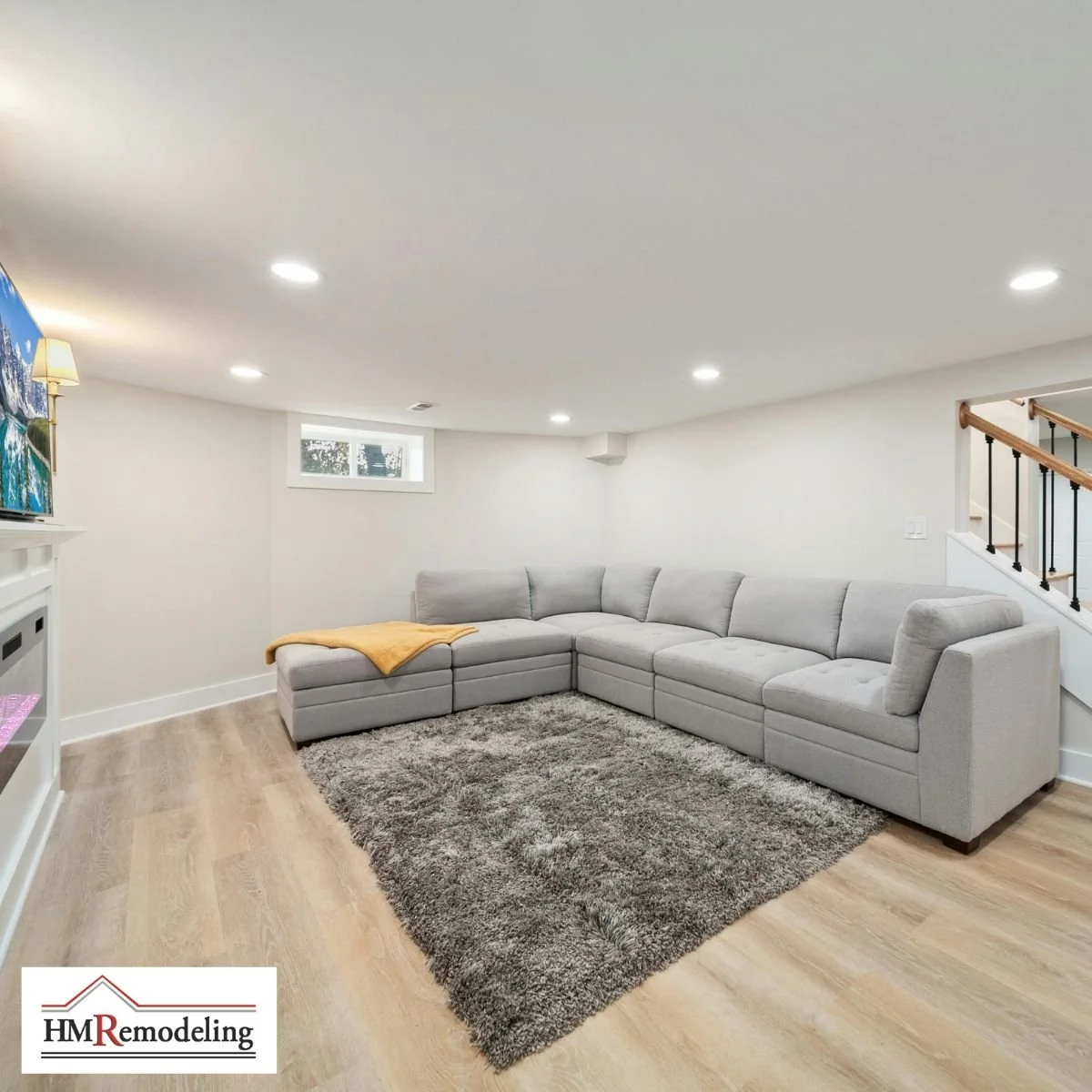
A bright, welcoming finished basement living room featuring a large gray modular sectional sofa arranged over a plush charcoal shag area rug on light wood-tone luxury vinyl plank flooring. Recessed ceiling downlights are evenly distributed across the white painted ceiling, providing clean, comfortable ambient illumination throughout the space. A small egress window admits natural light on the back wall, while a wall-mounted television and white painted built-in cabinet unit with open shelving occupy the left side of the room. A natural oak and black iron baluster staircase leads to the main floor on the right. White painted drywall, crisp white baseboard trim, and a mustard yellow throw accent complete the finished, move-in ready appearance. This image reflects the quality basement living space transformation HM Remodeling delivers to homeowners throughout South Bend and the Michiana region, converting underutilized below-grade areas into comfortable, appraised square footage that improves both daily life and home value.
